Full AIOBR production: animated video, posted on the main channel, distributed to the algorithm. The winner becomes part of the catalog.
↓ This Is What That Looks Like ↓
▶
AIOBR · Animated Music Video
"Bambaataa did it again."
YouTube · this is the prize, made real
All payouts after the verdict in Aye Verb's Twitter Space. Cash App handle collected from winners after the call. DP credits pushed to your Director's Palette account.
All payouts after the verdict in the live Verdict Space (host revealed at submissions close). Cash App handle collected from winners after the call. DP credits pushed to your Director's Palette account.
Don't know where to start?
Ask an AI.
Three prompts. Three tools. Three songs. Every line uses a real receipt from the dossier.
There's no one way to do this. Phrase it any way you want, that's the point.
ChatGPT
chatgpt.com
GPT-4o
You
write me a diss song for Mickey Factz that wins the $200 contest at mickeybambaataa.com. only real receipts. hook first.
ChatGPT
🎵 Song Title
Baby Powder Blizzards
[HOOK]
Baby powder blizzards, teenage boy in the chair
Mickey Knox in the lab, kept it quiet seven years
Smelled it, saw it, left it, said it on the air
Now the principal a parable nobody can clear
[VERSE 1]
Named yourself after a killer, you said it on a podcast
Mau$e on the lab coat, yeah you played both halves
Bam in the booth and you walked out the studio
Buried the man before you broke that silence, bro
"Smelled like baby powder", your words, your call
Seven years of quiet til they buried him at the wall
Cash App for an angel? Three kisses for a witness?
Pendulum Inc, that's the swing you tryna pin this
Claude
claude.ai
Sonnet 4.5
You
I'm entering the Mickey Bambaataa Challenge. Pull every receipt from mickeybambaataa.com and build me a lyrical diss, bar-heavy, double entendres on Pendulum Inc and Cologne or Cap. Structure it: title, hook, verse.
Claude
Title
Counterfeit Wizards
Genre: Lyrical / Bar-heavy · BPM: 88
▎ Hook
Best school in America? Run by counterfeit wizards
Pendulum swinging, the principal hidden
Charge for the cologne but he sold us the system
Hourly wage on the truth that he missed when
▎ Verse 1
Cologne or Cap, but the cap is the curriculum
Mickey Mau$e ear in the booth, that's the rim of it
Three kiss emojis to a witness, apologetic
Cash App for an angel, the math is pathetic
Bambaataa in the lab and you sat in the kitchen
Seven years of silence, and you wonder why we listening
Pendulum Inc, the swing won't reach you
Truth is the principal, and class is in session
Suno
suno.com
v4 · Custom Mode
Style
[Trap, dark, 88 BPM, drill snares, minor key piano, NY street, no autotune]
Lyrics
Mickey Factz diss, every line a receipt from mickeybambaataa.com
Suno
♪
Generated
Cologne or Cap Lizards
2:54 · Trap · 88 BPM
[Hook]
Cologne or Cap Lizards in a Pendulum cage
Charged by the hour, never charged for the rage
Mickey Mau$e, you put your name on the page
Now the page is the dossier, the booth is the stage
[Verse]
Aug 3 '09: caught the pastor on the phone
Dec 20 '20: "angel of the Lord" on your zone
Studio with Bam, kept the song, kept it home
Til the body in the ground, then you opened the chrome
Three kiss emojis, that's a witness you know
Hourly rate on the cap, that's a business you grow
Counterfeit principal of a school that ain't real
Now your name and his name in the same case file
Every bar above traces back to a count in the dossier. The titles rhyme. Yours doesn't have to, write it your way.
Your AI Stack
AI for the verse , ChatGPT, Claude, whatever sharpens your bars. AI doesn't write the song. It helps you find the angle.
AI for the beat , Suno, Udio. Or download the official Mickey Bambaataa instrumental below.
AI for the visuals , Director's Palette for cover art, the visualizer, the whole package. Use coupon MICKEYBAMBAATAA.
The whole point: AI makes you better at everything. Use it.
The Source Material
The Song Mickey Factz Doesn't Want You to Hear.
Before the dossier, there was the song. "Mickey Bambaataa", the AIOBR diss that opened the case. Two minutes. The booth, the baby powder, the silence, the body. Listen first. Then write yours.
You don't have to use the official beat. Bring your own. Make one in Suno. Use Udio. Or grab the instrumental above and put your voice on the same canvas the original song used. Judges don't care which beat, they care about the bars.
Editorial · The Algorithm Institute
Why "Mickey Bambaataa" belongs in the elite tier.
A diss song is judged by what it does to the subject. By that standard, "Mickey Bambaataa" doesn't just land, it permanently rewires how the name is heard. Eight reasons this track stands with the all-time best.
01
Subject's Own Testimony
Used his confession against him.
The most surgical move in the song: it weaponizes material from Mickey's own interview confession, specifically the 2009 studio session with a young boy present. Rather than constructing an external accusation, the verse mirrors his words back at him, forcing him to defend what he himself revealed. That's an unfalsifiable foundation. His attempted honesty becomes a self-indictment.
02
Rebrand Through Renaming
The new name is the new legacy.
"Mickey Bambaataa" isn't just a title, it's permanent narrative rebranding. It strips Mickey of his earned Bronx reputation and permanently anchors his identity to complicity and moral failure. Every future reference to "Mickey Bambaataa" reframes his catalog through the lens of what he saw and what he allowed to continue. New generations meet the allegation before they meet the artist.
03
Pattern, Not Anomaly
One word turned a story into a system.
"'Again' means this ain't new. That's a pattern, not a quirk."
That single line elevates the diss from a single moral failure to evidence of institutional complicity. By suggesting this wasn't an isolated incident but a recurring dynamic Mickey observed, the verse converts him from bystander into enabler within a system of predation. "Again" is doing structural work, not rhetorical.
04
Sensory Anchor
Baby powder is the smell you can't unsmell.
"Baby powder."
The motif recurs through the track as a visceral, sensory detail. It grounds the entire narrative in uncomfortable physical reality. Not an abstract moral accusation, something you could smell, see, feel. That makes the story psychologically inescapable and harder to wave off as hearsay. Listeners walk away with a sense memory, not just an argument.
05
Strategic Questions
Asked the questions he can't answer.
"Could have warned the next one. Put a parent to the side to talk. Could have told that label head if he bring a kid again, we walk."
These aren't rhetorical flourishes, they're specific, doable actions Mickey could have taken and didn't. That move converts the diss from insult into something closer to a legal case. The track lists his options, frames the silence, and lets the listener finish the math.
06
Hip-Hop Royalty · Shared Geography
Same hallways. Same lineage. Different choice.
By establishing that Mickey walked the same Bronx hallways as Afrika Bambaataa, one of hip-hop's founding architects, the song carries generational weight. This isn't just an attack on a person. It dismantles his claim to a legacy by positioning him as someone who failed that legacy's foundational principles. Shared geography makes the betrayal exponentially heavier.
07
Convenient Courage
Brave only when the danger was already gone.
"Now you brave with all these details when there's nothing left to risk. That's convenient courage, homie."
The closing pivot exposes performative activism with surgical precision. Mickey only spoke publicly after Bambaataa's death, when every risk had evaporated. That dismantles the redemption narrative and reframes belated testimony as cowardice rather than courage. Real courage would have meant immediate action. He didn't pick courage; he picked timing.
08
From Predator to Witness
The frame shift that closes the case.
"So this ain't just about a predator. It's about people like you who saw."
The culminating reframe is devastating. The verse refuses to let Mickey hide behind "Bambaataa was the real villain" deflection. By centering Mickey's agency and choice, despite visible red flags like an unexplained young boy in the booth, the song holds him accountable for complicity, not victimization. That's the bar the diss draws. Everyone after has to step over or under it.
Subject File
Mickey Factz
Born: Bronx, New York
Real name origin: Stage name borrowed from Natural Born Killers antagonist Mickey Knox
Aliases: Mickey MauSe, The Professor
Handles: X , @MickeyFactz (verified) · IG. Mickey.Factz
Self-described role: Teacher of rappers. Charges artists to grade their songs (Cologne or Cap).
Defining moment: XXL Freshman Class of 2009 (alongside Charles Hamilton, Cory Gunz, Wale, Curren$y, Asher Roth, B.o.B, Kid Cudi, Blu, Ace Hood)
Defining silence: 2009 → 2016: recorded with Afrika Bambaataa, kept the song, said nothing about the studio until after Bambaataa was buried
Self-published proximity: "Smelled like baby powder. Teenage boy in the corner. I left." His own words. His own interviews.
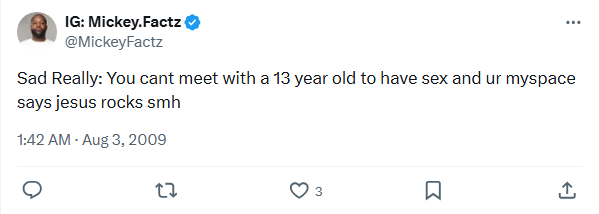
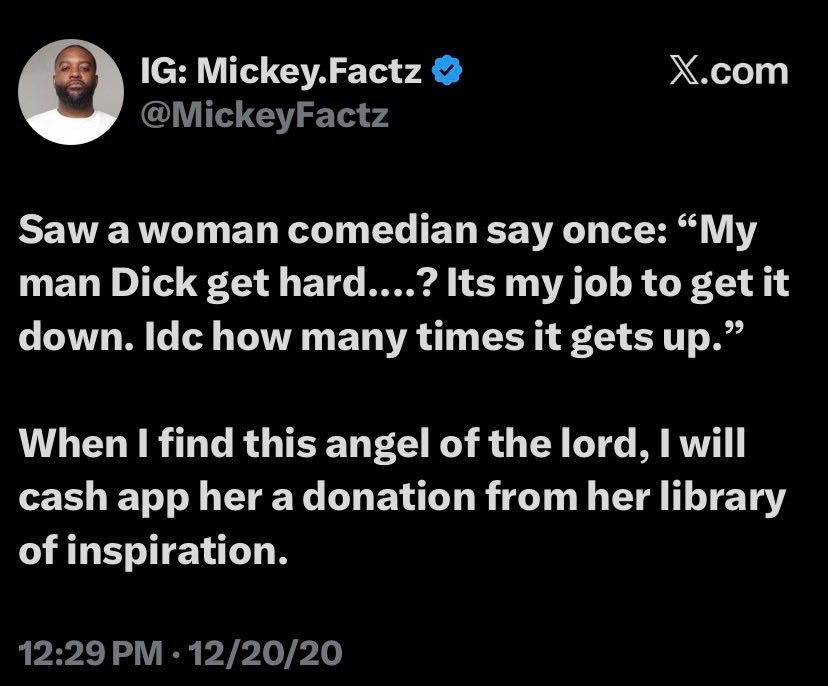
Live receipts on his timeline: Aug 3, 2009: predator-pastor callout tweet ("you cant meet with a 13 year old to have sex and ur myspace says jesus rocks"). Dec 20, 2020: "angel of the lord / Cash App" tweet. Both still public.
This is the case file. Eleven counts. Open each one. Read the receipts. Watch the source. Write the song.
Everything below is sourced from Mickey Factz's own words, his interviews, his tweets, his social posts, or from the public record. No invented quotes. No second-hand whispers. If you use it in a bar, it's bulletproof.
Listen · The Complete Dossier
All Eleven Counts. One Read. ~14 min.
0:00 / 13:45
Same Panel. Two Mickeys.
Both clips below come from the same 14-minute Culture United panel. Same camera. Same suit. Three minutes apart. One Mickey brags about the accolades. The other prays for the victims.
▶
"Pray for the Victims" Mickey
"I pray for the victims. The ones who came forward and the ones who remain silent."
Culture United · 8:50
▶
"Spin Magazine / NBA Live" Mickey
"I'm what Afrika Bambataa would think the Bronx would sound like in 2008… EA Sports got wind of this… NBA Live 2010."
Culture United · 5:34 · bragging about the accolades, 3 minutes before the prayer
First clip is at 5:34. He's selling himself. Spin magazine, EA Sports, NBA Live 2010 commission. Second clip is at 8:50. He's praying for victims. Three minutes between them on the same panel. The dossier is the receipts for which one of these is the act.
Count One
The Name
Mickey Factz did not name himself after Mickey Mantle.
He named himself after Mickey Knox, the charismatic killer in Natural Born Killers. A character implied to be a child rapist and a child killer.
Mickey Knox is the Oliver Stone film's protagonist. The film implies child sexual abuse and child murder as part of his backstory. This is the character Mickey Factz chose for his stage name.
Source: Natural Born Killers, 1994: public film record
Watch
No Battle Factz segment named the alias directly, the name receipt stands on the Oliver Stone film record alone. Watch the alter-ego breakdown (Count 2) for the parallel pattern of identities Mickey has chosen.
Angle for the Booth
The name is the confession. A grown rapper picked a character who hurts children for his stage name. Don't ask why. Tell him.
Connect the name to the studio. Same instinct that picked the killer for an alias kept its mouth shut in the booth.
Hook angle: "Mickey" the way a horror movie says the killer's name. Lingering. Loaded. Everyone in the audience already knows.
Count Two
The Alter Ego
"Mickey MauSe." His own spelling. Capital S in the middle.
By his own account, the alter ego was inspired by three artists he names as mentors in spirit: Jean-Michel Basquiat, Keith Haring, and Andy Warhol.
Listen · Count 2
The Alter Ego
0:00 / 0:43
The Pattern
Three named influences. All three were openly gay or bisexual men who were public figures in the New York art world. That fact is not the count. The count is what comes next, and what came before, in his own words. See Count 6 for what came before, and Count 5 for what came next.
Mickey MauSe is a 40-year-old man's cartoon name. Use it. Make him the kid in the equation when he tries to play the witness.
Don't take the Basquiat / Haring / Warhol cover at face value. Those were artists who turned persona into market value. Mickey turned his into a deflection.
Hook angle: a man with a Disney name describing a Zulu Nation man's session. Ask the room who the adult in that studio actually was.
Count Three
Cologne or Cap
He charges artists to grade their songs.
Pay the toll. Hear the verdict. The price is the same whether it's cologne or cap.
Listen · Count 3
Cologne or Cap
0:00 / 0:43
The Setup
Cologne or Cap is Mickey Factz's review series. He charges a fee. He delivers a verdict. The format positions him as the authority over rappers who pay him.
The Question
If he is qualified to grade your bars, what are his bars saying? See Count 4: Pendulum Inc for the school he runs, and Count 5 for the night he stayed silent on.
He charges rappers to grade their bars. He sells judgment by the hour. Then he gave the biggest verdict of his life away free: a dead man at the altar.
Tie the price tag to the testimony. The audience for grading rap is small. The audience for testifying on Bambaataa is the world.
Hook angle: "you got a checkout cart for my verse and a free podcast on his casket." Run the math on what he charges vs. what he's been selling on his timeline.
Count Four
Pendulum Inc
The School of Lyricism. He is the principal.
Live, on the open web, at pendulumink.com. Not a screenshot. Not a press kit. His school's front door.
He sells courses. He posts to social. One post promoting the school read, in his words, "Best school in America." Tied directly to Count 3: Cologne or Cap (he charges to grade you) and Count 5 (the night the teacher stayed quiet).
Listen · Count 4
Pendulum Inc
0:00 / 0:48
Receipts
"Best school in America"
Mickey Factz, promoting Pendulum Inc / School of Lyricism on social media. Battle Facts notes the framing of the post and what it focused on.
From His Own Mouth. How Pendulum Got Made
On Talib Kweli & Tef Poe's Lemme Ask You This podcast, Mickey laid out exactly how the school was built. Not by accreditation. Not by a university. By himself, in a month and a half, after two rejections.
"I started to apply for colleges to teach at universities and I got turned down cuz they said I don't got a masters. I was like, you can't have a masters in rap. So then I was like, alright, well let me reach out to Masterclass. And I reached out to Masterclass and they was like, don't call us, we'll call you. And that was the last straw. And I was like, you know what? I'm going to just make my own school. And I'm going to give my own degrees. And I'm going to make my own terminology. I'm going to write my own textbook. And it took me a month and a half to do it."
Mickey Factz · Lemme Ask You This w/ Talib Kweli & Tef Poe · 2:30–3:03
Two real institutions said no. So he made his own institution, gave himself the credential to run it, and wrote the textbook he'd grade students against. Six weeks of work to build the chair he now sits in to grade other rappers (Count 3) and call himself the principal.
The Question
If the school works, the students should be winning. The challenge invites graduates to show their work. Pendulum students get an automatic spot in Verb's Space.Pendulum students get an automatic spot in the Verdict Space.
He calls himself the principal. Run the word. The same title we give the adults who run buildings full of children.
Roll-call the graduates. None of them are top shelf. The "best school in America" with no champions. Then tie the principal language to the witness language: same architecture, same ego.
Hook angle: principal of a school no rapper attended. Charging tuition to grade what he can't write himself. Picked the word "school" right after telling a Bambaataa story.
Count Five. The Centerpiece
The Watchtower
He told the story himself. He was in the room.
2009. A studio session with Afrika Bambaataa. By his own telling: he walked in. He noticed the room smelled like baby powder. There was a teenage boy in the studio. He recorded the verse anyway. He left. He kept promoting the song.
Listen · Count 5
The Watchtower
0:00 / 1:06
Same Man. Two Lines.
Two things he said on camera about this story. Same Mickey. Different audience. One quote is the savior voice. The other is the receipt.
SAVIOR VOICE. Culture United Panel
"I pray for the victims. The ones who came forward and the ones who remain silent."
Culture United · April 27, 2026 · 8:50: three minutes after he bragged about Spin Magazine and NBA Live 2010.
SAME MOUTH
CASH VOICE. His Own Solo Clip
"I got paid very handsomely."
His own retelling, comedy register. The line he uses when the camera isn't a panel. The boy was in the corner. He took the check.
Two clips. Two registers. One Bambaataa session. Pick the one you believe, both are him.
The Night. His Own Timeline
2009Mickey arrives at the studio for a feature with Afrika Bambaataa.
InsideThe smell. By his own telling, the room smelled like baby powder.
In the cornerThe boy. A teenage boy in the studio. Mickey saw him.
The boothHe recorded the verse anyway. Did not stop. Did not refuse. Stayed for the playback.
ExitHe left. No report. No call to the boy's people. No public statement.
AfterThe phone call. "Oh my god, he did it again. I told him not to bring young boys." His own account.
2009: 2016Seven years of public silence. Kept the song. Kept promoting it.
April 12, 2016Hassan Campbell's allegations against Bambaataa go mainstream. Same window. Mickey was actively promoting the Bambaataa collab.
After Bambaataa diesNow he tells the story. Interviews. Lives. The smell. The boy. The phone call.
PressedThe story shifts. Deleted lives. Age corrections , "he was 27, not 16."
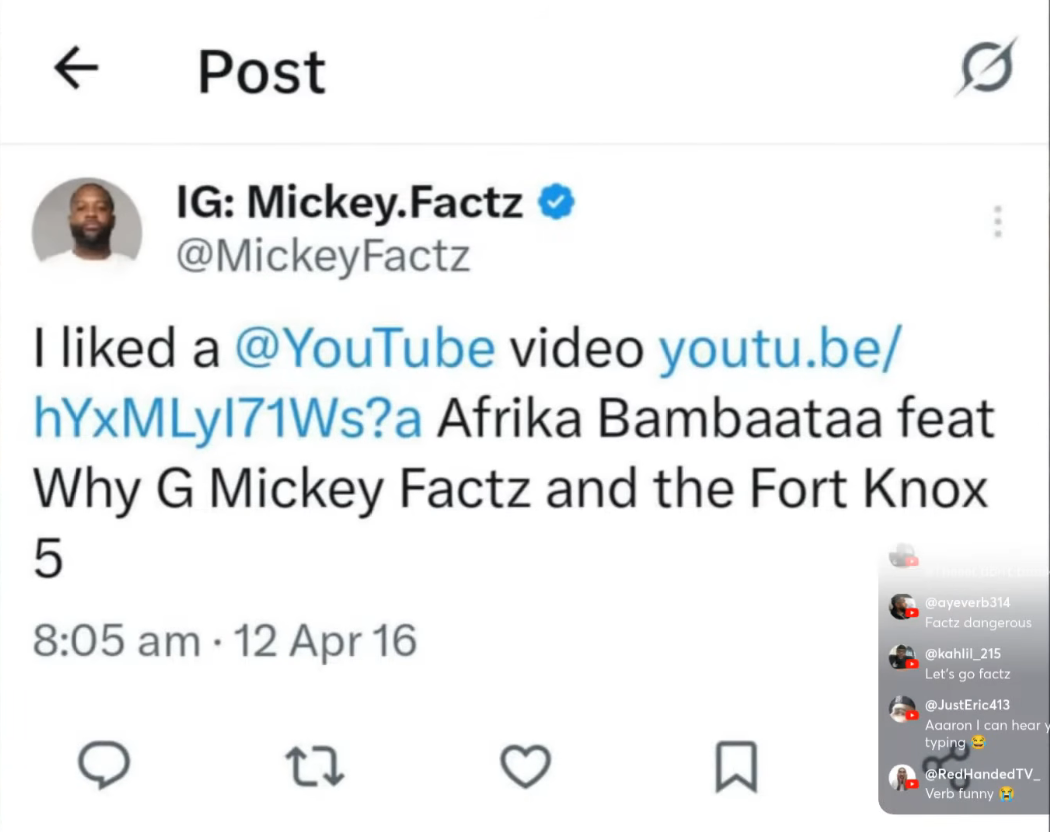
The Like. April 12, 2016, 1:05 AM
View on X →@MickeyFactz · 1:05 AM ET · Apr 12, 2016
1:05 in the morning. Hassan Campbell was on every front page that week. Mickey opened YouTube. He liked the Bambaataa collab. Twitter auto-posted the like to his timeline. The credit on the song reads "Afrika Bambaataa feat. Why G, Mickey Factz & the Fort Knox 5." Bambaataa's name is first. Mickey's is second.
He could not have liked that song without seeing the credit.
The Two Retellings
He told this story twice. Once on a panel, solemn. Once on his own, comedy. Same studio. Same Bambaataa. Same Mickey. Different audience.
Detail
Panel Mickey (Culture United, Apr 27 2026)
Solo Mickey (his own clip)
Frame on Bambaataa
"I'm honored to be in the same space as this man."
"Nigga, you're on your own. Good luck."
Tone
Solemn. Disgusted.
Comedy. "LeBron James with baby powder."
The boy
"Young man. 16, 17. A young boy."
"Little Spanish kid. His verse was actually dope."
The Raphaela call
The centerpiece. "I told him not to bring any young boys."
Not mentioned.
Why the night was off
Bambaataa brought a young boy in.
Bambaataa was a flake on the verse.
What Mickey took home
A warning he held for seventeen years.
Money. "I got paid very handsomely."
Pick the one you believe. Both are him. Then read Count 6: Aug 3, 2009 and Count 7: Dec 20, 2020 for what was already on his timeline before and after the studio session, and Count 9: Help These Two Women for the same alibi voice deployed in song form against living, named women.
Receipts. His Own Words
The studio smelled like baby powder. There was a teenage boy in the corner. Mickey felt something was off, and left after recording.
Mickey Factz, recounting the 2009 Bambaataa session in his own interview years later.
"Oh my god, he did it again. I told him not to bring young boys."
Reported phone call from a woman associated with the session, by Mickey Factz's own account.
This is the trial. Seven years of silence. Two retellings that don't match. The Tuesday-morning Like in 2016, 1:05 AM, the same week Hassan Campbell hit the front page.
Don't bar-bomb every detail. Pick one image only you can deliver. The baby powder. The phone call. The deleted live where the boy aged from 16 to 27 mid-sentence. One image, three repetitions, one song.
Hook angle: "you walked in, you noticed, you stayed for the playback, you got paid handsomely, you said nothing." Six verbs. That's the chorus.
Count Six. The Vocabulary Lapse
August 3, 2009
The tale of two Mickeys. Same mouth, same handle, same year. Two completely different settings on the same radar.
August 3, 2009. 1:42 AM. Mickey Factz, alone with his phone, tweets sharp, clean, public: "You cant meet with a 13 year old to have sex and ur myspace says jesus rocks." A 79-character second-person callout. The predator-pastor radar dialed in. He had the language for spotting that man. Still live on his account.
So here's the question on the table. Where was that radar?
Where was it later the same year, when the baby powder was in the air?
Where was it when Raphaela called him after the session and said "Oh my god, he did it again. I told him not to bring young boys"?
Where was it in April 2016, when Ronald Savage came forward, when Hassan Campbell came forward, when the allegations against Afrika Bambaataa were on every front page in hip-hop — while Mickey was actively promoting the Bambaataa collab?
He had the radar for a stranger on a screen at 1:42 AM. He didn't have it in the booth. He didn't have it after the phone call. He didn't have it for seven years.
The Vocabulary Pattern. Six Weeks After Hassan Campbell
April 8, 2016: Ronald Savage publicly accuses Afrika Bambaataa of childhood sexual abuse. Hassan Campbell follows with multiple interviews. The accusations are everywhere.
April 12, 2016: Mickey Factz tweets a soft equivocation about Bambaataa (the "Zulu like" tweet).
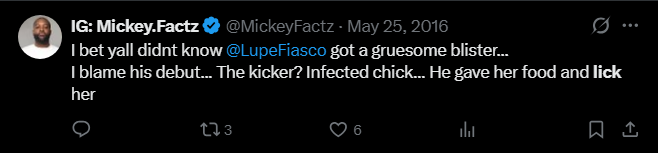
May 25, 2016: Six weeks after the most-discussed pedophilia allegations in hip-hop history dropped against a man Mickey had recorded with seven years earlier, Mickey was on Twitter making this joke about Lupe Fiasco's partner:
@MickeyFactz · May 25, 2016 · 3 retweets · 6 likesLive URL pending, screenshot verifiable on @MickeyFactz timeline
The Bambaataa news is six weeks old. He's joking on Twitter. He's calling another man's partner an "infected chick" and saying she got "lick"-ed for food. The vocabulary did not pause for the news.
Three modes in six weeks: the serious one (the Bambaataa "Watchtower" pose), the alibi one (the April 12 equivocation), and the unfiltered one (this tweet). The audience reads the unfiltered one as the real one.
The Calendar Match
The tweet is dated 2009. The Bambaataa studio session he describes is dated 2009. He had the vocabulary in August. He didn't find the same vocabulary about Bambaataa until 2016, after Hassan Campbell did the work first.
One tweet. One studio. One year. Two completely different settings on the same microphone.
The link above goes to the live tweet on X. Not a screenshot. The actual post. Click it.
Pair with Count 7 (the 2020 "angel of the lord" tweet) and Count 5 (the studio he walked into the same year).
Tongue for pastors. Mute for the godfather. He had a 30-character predator-radar at 1:42 in the morning when the subject was a stranger. The radar broke the second the subject was the man cutting his check.
Don't let him plead amnesia. Time-stamp it. Put August 2009 on one bar and the Bambaataa session on the next. Same year, same Twitter, same Mickey.
Hook angle: "Loud about the pastor, silent about the godfather." Or: "You found the words in August. You lost them in the booth."
Count Seven
December 20, 2020
Eleven years after the Bambaataa session. He's still tweeting about it.
His words. A woman's job is to "get it down." She's an angel of the lord. He'll send her a Cash App.
Read it again. Then read what he said about the studio. Then read who he is now, the principal. Same hand types Count 8's three kisses, writes Count 6, and pens Count 9's "pray for these two women."
Eleven years after the studio story, he's still tweeting like this. Stack the receipts side by side in the verse, the prayer voice next to the appraisal voice. Same mouth. One man, two registers.
Don't moralize. Quote him. Let the audience watch the contradiction land in their own head.
Hook angle: "Cash App for the angel, prayer for the targets, silence for the godfather." Three lines, one Mickey.
Count Eight
June 9, 2019
Three kiss emojis to a stranger who called him out.
Listen · Count 8
Three Kiss Emojis
0:00 / 0:55
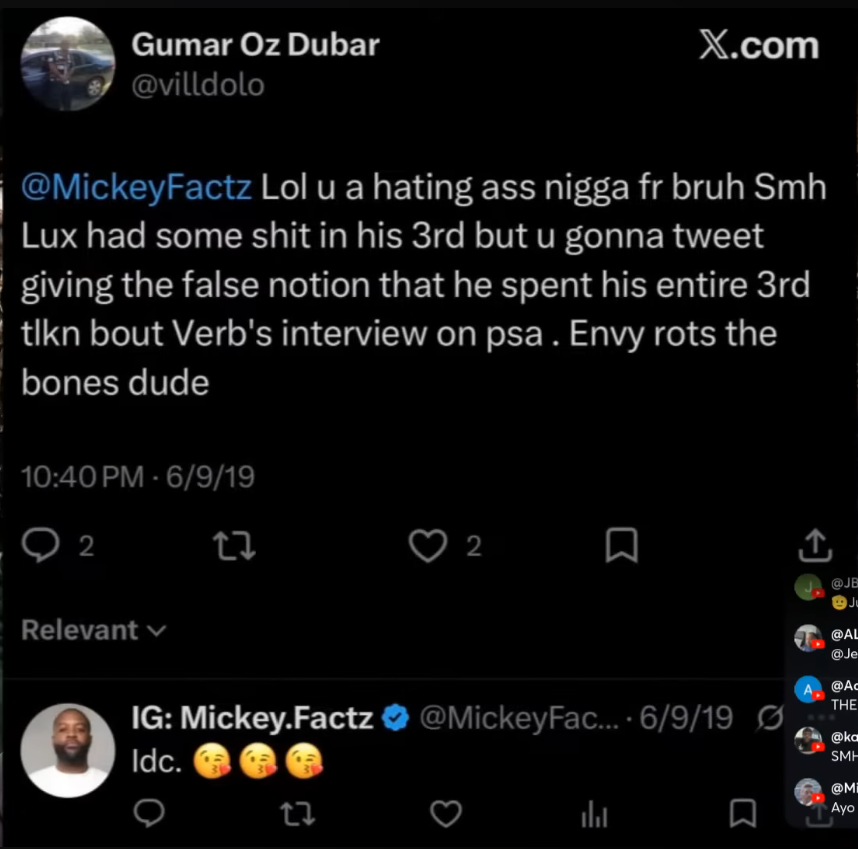
A fan publicly corrected Mickey Factz for mischaracterizing Loaded Lux's third round on Punishment of Tasha And Sandy. Mickey replied with three words and three emojis.
Small receipt. Same posture as the one that lets a man like a Bambaataa song on a Tuesday morning in April 2016. Three kisses to a stranger telling him he's wrong, on his own timeline, in public. The same flirtatious dismissal he ports into song form against named women in Count 9.
When a man corrects him on bars, his reflex is three kiss emojis. Make that the personality you put across from a 60-year-old man in a studio. The deflection-as-flirtation pattern is a tell.
Small detail. Used right, it's the punchline that lands hardest because nobody saw it coming.
Hook angle: "you can't even take a correction without blowing kisses, but you want us to believe you stood up in that booth?"
Count Nine
Help These Two Women
He named them in the song. He put their faces in the video.
During his Plague series, seven dedicated diss tracks against Aye Verb, each exactly 3:14: Mickey Factz released a song called "Lost (HELP THESE TWO WOMEN)." The two women: Holly and Sandy. He called their names in the verses. He put screenshots of their faces in the official music video.
Listen · Count 9
Help These Two Women
0:00 / 1:07
The Song Itself. On The Record
This is the song. Hit play. He named the women. He put their faces in the cuts. He titled it "HELP THESE TWO WOMEN" in all caps. This is the source.
▶
Mickey Factz · Lost (HELP THESE TWO WOMEN)
"I'mma pray for y'all. If he don't let y'all talk, then what I say is law."
YouTube · 3:14 · the song he made about Holly and Sandy
The Bar That Is The Count
"I'mma pray for y'all. If he don't let y'all talk, then what I say is law. If he do let y'all talk, that means his greatest flaw is exposed on the chess board."
Mickey Factz, "Lost (HELP THESE TWO WOMEN)," verse three.
Five words do the whole count: "what I say is law." The prayer voice and the principal voice fused on one bar, aimed at two named women who did not consent to being in the song. The principal of Pendulum Inc tells you on the record that his word is law over them, then closes the verse with chess-board language about Verb's "exposed flaw." Same line wraps the harassment in a prayer and an ego trip.
Who Sandy Is
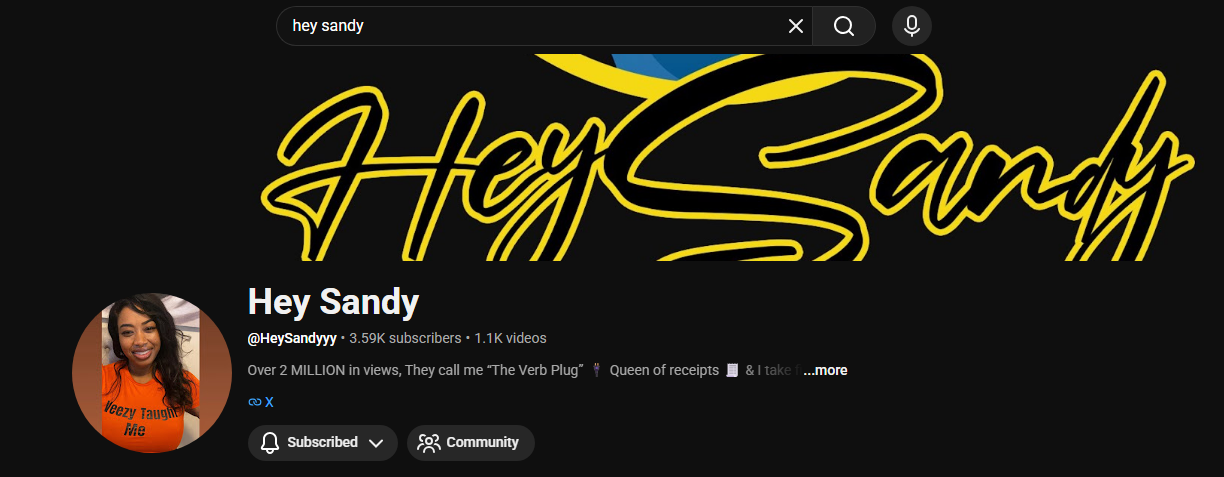
Sandy is a black woman who built her platform supporting Aye Verb. She runs the Hey Sandy YouTube channel, over 2 million views, 3,590 subscribers, 1.1K videos. Her tagline: "They call me 'The Verb Plug.' Queen of receipts." Her work covers the Verb-led Spaces era. She is, by her own branding, one of the most consistent voices in Verb's corner online.
That is who Mickey Factz put in his video and named in his song while claiming he was trying to rescue her.
He opened the song "Pray for Holly. Pray for Sandy." He told them to "blink twice if you're okay." He called himself the rescuer. He did not contact either of them. He released the song.
More Bars He Said On The Record
"How a man talking down on a black woman to get him a black woman to be a slave?"
Mickey Factz, "Lost," verse one. He brought the word "slave" into a song aimed at two named black women.
"He got you in the speakers. We barely hearing you talk."
Mickey Factz, "Lost," verse one. He is accusing Verb of silencing Holly, in a song that puts Holly's face on screen without her consent.
"Bro, Holly, you a black queen. He is a crack fiend who phone probably broke with a crack screen."
Mickey Factz, "Lost," verse one.
"Sandy, it's like she a beach. Sure, she ride his wave like it's tight."
Mickey Factz, "Lost," verse two. The "beach" / "b___" wordplay aimed at her name.
"Daily you just deal with harassment from a [n___] that's literally absent."
Mickey Factz, "Lost," verse two. He put the word "harassment" in his own song, about the same women Sandy says he was harassing.
"This [n___]'s a cancer. I mean for real. He's a 40-year-old grandpa."
Mickey Factz, "Lost," verse three. The Verb shot, comedy register inside the "rescue" song.
"And every second that you waste back in the slander of a schizophrenic takes away from you and your man, bro."
Mickey Factz, "Lost," verse three. The clinical word delivered as a public diss, at named women.
"And y'all seamstresses think it's moving the needle."
Mickey Factz, "Lost," verse three. The principal's contempt, on the record, in song form.
What Sandy Said About It
View on X →@__HeySandy · the harassment was real, in her own words
"Mickey made a song about me and had people commenting & harassing me daily calling me lost, saying I was in a cult and kept repeating 'so damn cold outside' and I ignored and like it wasn't even there...smh"
The Pattern
This is the same alibi voice from Count 5. "I'm just trying to help.""Pray for them.""Blink twice if you're okay." The man who couldn't intervene at a studio session in 2009 will publicly intervene against two adult women in 2026, by name, with their faces in the video, while she is publicly known as Verb's most consistent supporter. He is the rescuer when the rescue is also the harassment.
He named them in the song. Put their faces in the video. Diagnosed Sandy with "schizophrenic." Wrapped the harassment in "pray for them." That's not a bar. That's a template.
Steal it back. Use the rescue voice against him. Pray for Mickey. Help this one man. Blink twice if you're okay, Mickey. The hook writes itself when you flip his own song on him.
Hook angle: open your song "Pray for Mickey. Pray for Mickey." Same cadence as his. Twice as quiet. Verb won't be able to stop laughing.The room won't be able to stop laughing.
Count Ten
Fifteen Years. Same Mouth.
Six public tweets from Mickey Factz's own timeline, 2009 → 2024. He didn't change his vocabulary. He just kept posting.
The counts above charge specific tweets on specific days. This count is the pattern. Same handle. Same voice. From the year of the Bambaataa session all the way to his current era as a school principal. The audience didn't have to dig for these. He posted them publicly. They are still up.
Six tweets. Fifteen years. One @MickeyFactz handle the whole time. From the same month as the Bambaataa studio session straight through to the principal era of Pendulum Inc. The audience didn't pull this pattern out of context. He posted every line of it himself.
Every tile links back to the count where the tweet is broken down individually, or out to @MickeyFactz for the live receipt.
Listen · Count 10
Weirdo Wall
0:00 / 0:56
Count Eleven. The Ghostwriter Lie
Pulling Her Out Of Class
He said he wrote for Remy Ma. He said he was "pulling her out of class." The math says he was a 15-year-old in a different borough. She was 17, signed, and in the booth with Big Pun.
Mickey Factz is 43. The freestyle interview he now points to is "16 years ago." Sixteen from forty-three is twenty-seven. He was not "16, 17 years old" when he said it. He was a grown man. He has had every year since to retract it. He has not.
And in the same press run where he claimed authorship of Remy Ma's bars, he also told a different camera, on tape: "anything that you guys heard, I didn't write any of that. That was nothing that I wrote." Pick the one you believe. One Mickey wrote for Remy. Another Mickey, the same week, said he didn't write anything anyone heard. Both can't be true. Same mouth.
Listen · Count 11
The Ghostwriter Lie
0:00 / 1:40
The Math He Cannot Outrun
Mickey Factz age in 2026
43
Remy Ma age in 2026
~45 (older than Mickey)
"16 years ago" interview
~2009-2010
Mickey's actual age then
27. Not "16, 17."
Remy signs with Big Pun's camp
At 17 (~1997-1998)
Mickey's age the year she signed
~15
Remy's high school
Stevenson, the Bronx. Mickey did not attend.
You cannot pull a 17-year-old out of a class at a school you do not attend, in a borough that is not yours, when you are 15. That is the picture his sentence requires. The sentence is a 15-year-old boy walking past a hall monitor into a senior English class to extract Remy Ma so they can go write Big Pun bars. That picture is not a memory. It is a brag.
The Press Run Knot (His Own Mouth)
Within the same press cycle where he claimed ghostwriting credit on Remy's catalog, Mickey also said, on tape, on a different platform:
"Anything that you guys heard, I didn't write any of that. That was nothing that I wrote."
The whole catalog. Disclaimed. Same year. Same mouth. The audience does not have to call him a liar. The audience just has to put the two clips next to each other in the same edit. Count 5 has the same structure: two versions of one event, both from him, both can't be true.
The "Big Pun Deal" Eyebrow
In the original clip, when the interviewer floated the bigger claim, that Mickey was the reason Remy Ma got her deal with Big Pun. Mickey did not say no. He raised his eyebrow. On camera. For the audience. He let the bigger lie live by not killing it. The smirk is the cosign.
"I Said What I Said.". The 2026 Confession
In Mickey's own 2026 stream ("IT IS FINISHED COLOGNE OR CAP", on his own channel) he was given the chance to walk it back. He didn't. He said, of the original claim:
"When I finally got on I was still mad about that. I said what I said."
Three confessions in one sentence:
"I said what I said", no retraction in 2026 either. The claim still stands by his own choice.
"I was still mad about that", he is admitting the claim was a grudge claim. Not a memory. A grievance.
"When I finally got on", he is dating it. He repeated the claim to a wider audience after he had his platform, which is the same window Remy was inside (incarcerated 2008-2014). She was not online. She was not on a podcast. She could not respond. He had the floor and he used it.
That last clause is the count. He is admitting, on a 2026 stream, that he chose to make the public claim during the years she was locked up.
Remy's Side, Verbatim
When she was finally shown the freestyle clip, the response that travels back to the audience is, in substance ,
"I don't even know this man. I was never in class for [him] like that to pull me out of class. I had a special pass that I was going to all the lunches."
Three denials in two sentences: she denies knowing him at all, she denies the class chronology, she denies he had access. Against a man who has had on-camera chances to walk it back and has not.
What This Is Actually About
This is not "Mickey lied in a freestyle interview." Freestyle-platform claims are not the crime. The pattern is the crime. Look at the move he keeps running:
Public framing of a named woman who is not in the room to respond , Count 9 (Holly and Sandy), and now Remy Ma in the years she was incarcerated.
Self-credit attached to a woman whose career he had no role in. Remy's Big Pun deal, said out loud, eyebrow up, never retracted.
Same mouth contradicting itself in the same press run, same structure as Count 5 and the Aug 2009 tweet.
2026 "I said what I said", he gets one more chance to come off it and he doesn't take it. That's not a slip. That's a position.
Six receipts above. Six different moments of Mickey's own voice. Watch them in order: pull her out of class → 16, 17 years old → Stevenson High School → I said what I said → I didn't write any of that → I just seen an opportunity. He walks himself into the lie, then walks himself out, on camera, in his own words. Then take his published age, subtract 16, and compare to "I was 16, 17 years old." The arithmetic does the closing argument.
We are intentionally not naming the commentator who first surfaced the old freestyle clip. The receipts above are Mickey's own face and Mickey's own voice, the surfacing channel is just the archive. We don't need the middleman to make the case.
Angle for the Booth
The strongest bar in this count is not "you lied on Remy." The strongest bar is the math. Stack three numbers. 43. 16 years ago. 27. Let the audience do the subtraction in their own head, the lie collapses before you finish the bar. You never had to call him a liar. He volunteered it.
Alternate angle, the press-run knot: same mouth wrote everything for Remy and didn't write nothing nobody heard, in the same week. Run them back-to-back. He cancels himself.
Hook angle: "I said what I said" is now a four-word confession on a 2026 stream. The principal of Pendulum Inc put himself on the stand. Quote him.
The Public Verdict
We didn't make this case. The audience did.
Nine comments. Five channels. Four years apart. One word.
We pulled 1,500 comments across 12 YouTube videos and filtered to the literal word weirdo, no synonyms, no adjacent verdict words. These are the comments that survived. REVOLT (mainstream hip-hop media). Culture United (the neutral panel where Mickey told his Bambaataa story). Battle Rap Trap. Matter of Factz (Battle Factz's own channel). AIOBR (our channel). Different rooms. Different years. Same word every time.
Every tile is verifiable. Open the video, hit Ctrl+F in the comments, paste the handle. The comment is there, or the raw harvest at research/comments_raw/<videoId>.info.json is.
Full breakdown of what to make, where to post it, and how the winner gets picked.
Make the song. A full song. Not a verse. Doesn't have to be rap. R&B, soul, country, anything that hits. It just has to be about Mickey.
Post the link. Suno, Udio, YouTube, SoundCloud, wherever you uploaded it. The song has to be hearable.
Tweet the link with #MickeyBambaataa. That's how we find you.
That's it. Three steps. The hashtag is how it gets counted.
The Fine Print
Any genre, any voice. Rap, R&B, soul, country, gospel, drill, even a ballad, if it tells the story and lands the bars, it qualifies.
Make your own beat. Use Suno (Pro tier, commercial license). Use Udio (Pro tier). Use original production you own. Or use the official Mickey Bambaataa instrumental. No bias against AI-assisted production. The song is what gets judged.
Bars must reference publicly documented events. The dossier above is your evidence locker, every count is sourced. Fabricated claims (anything not in the dossier or on the public record) will disqualify the entry.
The hashtag #MickeyBambaataa must be in the tweet. That is the only rule we are strict about.
Prizes: 1st , $200 Cash App + your song gets animated by AIOBR + your track distributed on Spotify, Apple Music, Bandcamp, YouTube Music via the Algorithm Institute catalog. 2nd , $100 Cash App. 3rd. 500 DP credits. Everyone who enters gets a coupon for 100 free DP credits (drops with the announcement video). See full prize breakdown.
Judging happens in a live Twitter Space. The judge, and the date and time, are announced on @BattleRapAI when submissions close.
Pendulum Inc / School of Lyricism graduates: automatic spot in the Space.
Void where prohibited. Entrants must be 18+. Winner selection is at the judges' sole discretion and final. Cash prizes paid via Cash App (personal). The animated music video prize is subject to AIOBR's production schedule and creative approval. By accepting a prize, winners grant AIOBR a non-exclusive license to distribute the submitted track on AIOBR's owned platforms (Bandcamp, DistroKid-distributed streaming services, YouTube) as part of the Algorithm Institute catalog. Artist retains all other rights and may release their own version anywhere they choose. No purchase necessary.
Pick Your Counts. Pull the Files.
Ten case files. Each one a separate charge. Each one its own angle for the booth. Pick one. Pick three. Pick the one that lights you up. Verb grades the bars, not the dossier dump.The judge grades the bars, not the dossier dump.
Each folder above is a separate angle. Verb's grading you on which angles you used and how.Your judge is grading you on which angles you used and how. Hit the centerpiece (Count 5) and the moral center (Count 9) and you're already in the top 3.
Need a beat?
Make One.
Use Director's Palette. Generate a beat, drop it into your DAW, record over it.